
Before you start
By LookScene Editorial, AI-assisted drafting and editorial review
Choosing where your hair divides seems simple until you spend twenty minutes fighting a stubborn cowlick or notice that an updated portrait feels unbalanced. Hair parting alters how light hits your forehead, how symmetry registers on camera, and how much effort styling requires each morning.
This guide focuses strictly on part placement and daily upkeep—not bangs selection, haircut length, or generic face-shape categories. It compares how three part positions perform on camera and in daily wear, how natural growth dictates styling, and how to test options before committing to a new cut or portrait.
The Visual Balance: Center, Off-Center, and Deep Side Parts
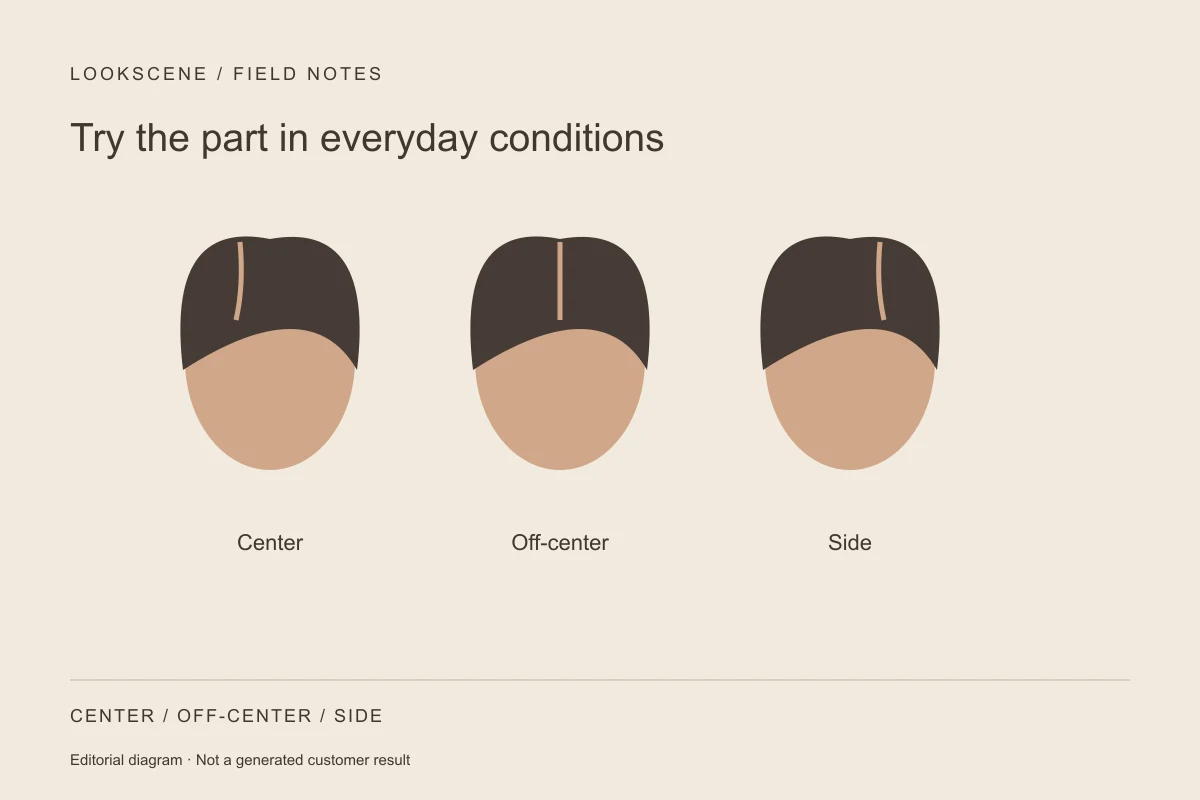
Where a part sits establishes the anchor line for your portrait, shifting volume and facial framing without altering hair length.
- Center Part (Middle Part): Dividing hair evenly along the nasal bridge creates direct vertical symmetry, drawing attention down the central axis of the eyes, nose, and jawline. While crisp and structured, its appearance and root volume depend on texture, cut, and styling.
- Off-Center Part (Subtle Side Part): Placed one-half to one inch away from center, this placement softens strict symmetry while retaining a balanced profile. It provides subtle root lift on the fuller side, offering a forgiving frame for minor facial asymmetry without a heavy visual tilt.
- Deep Side Part: Resting above the outer third of the eyebrow, a deep part sweeps substantial hair weight across the crown. This creates noticeable volume and dynamic diagonal lines in a portrait, though it requires intentional styling to prevent hair from falling forward.
Understanding these lines helps align your visual goals with realistic texture constraints, as detailed in our guide on hairstyle texture and maintenance principles.
Growth Direction and Cowlicks: Working With Natural Fall
A hairstyle looks effortless only when it cooperates with how follicles emerge from the scalp. Working against a strong growth pattern may take more styling effort.
Editorial guidance from grooming experts at Fellow Barber highlights that natural growth patterns and crown cowlicks strongly dictate where hair naturally divides. Aligning your part with the direction hair spirals from the crown minimizes root tension, whereas forcing hair against that flow may require extra styling; heat and heavy products are not always necessary.
Follicles cannot be permanently retrained to sprout at a different angle. While blow-dryers and pomades temporarily redirect hair shafts, ambient humidity or movement causes hair to revert toward its natural root direction. Cowlick patterns differ individually; there is no universal clockwise rule. A part that fights a strong cowlick may split again during the day, so test it in normal conditions.
Daily Styling Effort Across Part Placements
Visual preference must be weighed against your daily tolerance for maintenance. The table below lists things to test, not requirements that apply to every hair type.
| Part Position | Visual Impression | Daily Tool and Product Needs | Cowlick Sensitivity | Wind and Humidity Behavior |
|---|---|---|---|---|
| Center Part | Symmetrical, centered facial framing | Try a comb or fingers; extra tools may be unnecessary | Check whether a front cowlick separates the line | Observe your own volume and humidity response |
| Off-Center Part | Balanced, relaxed, subtle lift | Wide-tooth comb or fingers, light texturizing spray | Moderate; easily navigates minor crown asymmetry | Test whether hand reshaping works for your texture |
| Deep Side Part | Dramatic volume, sweeping diagonal lines | Blow dryer with concentrator nozzle, styling mousse, medium pomade | High; resists styling if swept opposite to crown spiral | Prone to falling forward; may need occasional adjustment |
A center part demands precision: a crooked line or shifting root makes the style look accidental. An off-center part can be easier for some people to maintain, letting you reshape hair with your fingers without ruining its structure. A deep side part may need help maintaining volume; there is no universal tool requirement, plus occasional adjustments throughout the day.
A Hypothetical Walkthrough: Testing a New Part for a Portrait
Consider a hypothetical professional, Jordan, who has worn a casual side part for years and wants to test a center part for an upcoming studio portrait.
- The Wet-to-Dry Fall Test: After washing, Jordan combs damp hair straight back with a wide-tooth comb. Shaking the head gently forward reveals where hair splits naturally. Jordan spots a crown whorl pushing hair slightly to the right.
- Visual Exploration via Neutral Previews: Jordan captures three front-on photos in consistent natural light: center, off-center, and deep side. To see how these options pair with different headshot backdrops, Jordan uses a free invitation preview on LookScene to explore personal photo styling options, checking jawline framing across positions.
- The All-Day Wear Test: Jordan styles a true middle part for a workday. By afternoon, the left front section collapses into Jordan's eyes, and the right crown section splits open. The next day, an off-center part three-quarters of an inch to the right stays in place with zero touch-ups.
- Stylist Consultation: Jordan brings natural fall photos to the salon, showing the stylist where the cowlick splits. To prepare clear references for your own cut, review our checklist on how to show your hairstylist what you want.
Tool Limitations and Practical Boundaries
Digital previews and styling guides help explore aesthetics, but they cannot replace physical evaluation:
- Visual Exploration Only: LookScene provides personal AI photo styling for hair, outfits, and settings for visual exploration where permitted. It does not offer physical haircutting, physical styling, exact clothing fit, or guaranteed identity preservation. Current invitation previews are free.
- Follicular Realities: AI previews cannot measure scalp health, hair density, root direction, or cowlick strength. A digital image can display a symmetrical part, but cannot predict if your roots will hold that line without heat styling.
- Destination Requirements: Always verify submission rules for official use. Government passports, professional licensures, and corporate ID requirements strictly override generated or altered previews.
- Health Boundaries: Neither digital tools nor editorial guides provide hair-loss diagnosis, scalp treatment, or objective beauty rankings. Ask a barber or stylist about a cut, and a qualified healthcare professional about persistent scalp concerns.
Choosing between a middle part and a side part is neither an objective beauty ranking nor an irreversible commitment. By testing your hair's natural fall in natural lighting and balancing visual symmetry against your daily styling patience, you can select a reference that looks polished in photos and remains practical throughout the day.
References and Community Discussions
- Fellow Barber Grooming Editorial: Guidance on examining crown cowlicks and growth direction to determine where hair naturally separates (Fellow Barber Guide).
- Community Inquiries: Recurring troubleshooting discussions from adults debating parting placement, cowlick resistance, and texture maintenance on r/curlyhair and r/Hair.
Style options to compare
Use these illustrated directions to plan what to try. They are not verified before-and-after results; inspect the review checklist on each page.
- Buzz cut — Check the original hairline, ears and scalp; do not interpret a preview as hair-density advice.
- Low fade — Check that both temples taper naturally and that the ears retain their shape.
- Classic side part — Check the part direction, forehead exposure and believable root volume.